




The government is preparing one of the most extensive interventions in the tax system in recent years, proposing changes that directly affect businesses, employee wages, the prices of goods and services, as well as how the tax administration will collect obligations.
The new fiscal package, which is set to be implemented from January 1, 2027, provides for both tax increases and decreases. On one hand, the government proposes reducing VAT on basic food items and easing the tax on a portion of wages, while on the other, it increases corporate profit tax, dividend tax, general VAT, and the rate for the tourism sector.

Another significant change concerns small businesses, as the threshold for mandatory VAT registration is proposed to be halved, bringing thousands of new entities into the scheme.
From the increase in corporate tax and dividend tax alone, the Ministry of Finance expects to collect about 8 billion lek more per year, or approximately 85 million euros.
The interventions are also accompanied by stricter measures for collecting tax obligations, while for certain categories of businesses, both payments to the state and administrative costs are expected to increase.
Skyweb.al presents below the key changes of the fiscal package and how they are expected to affect citizens and businesses.
VAT on food is reduced from 20% to 6%
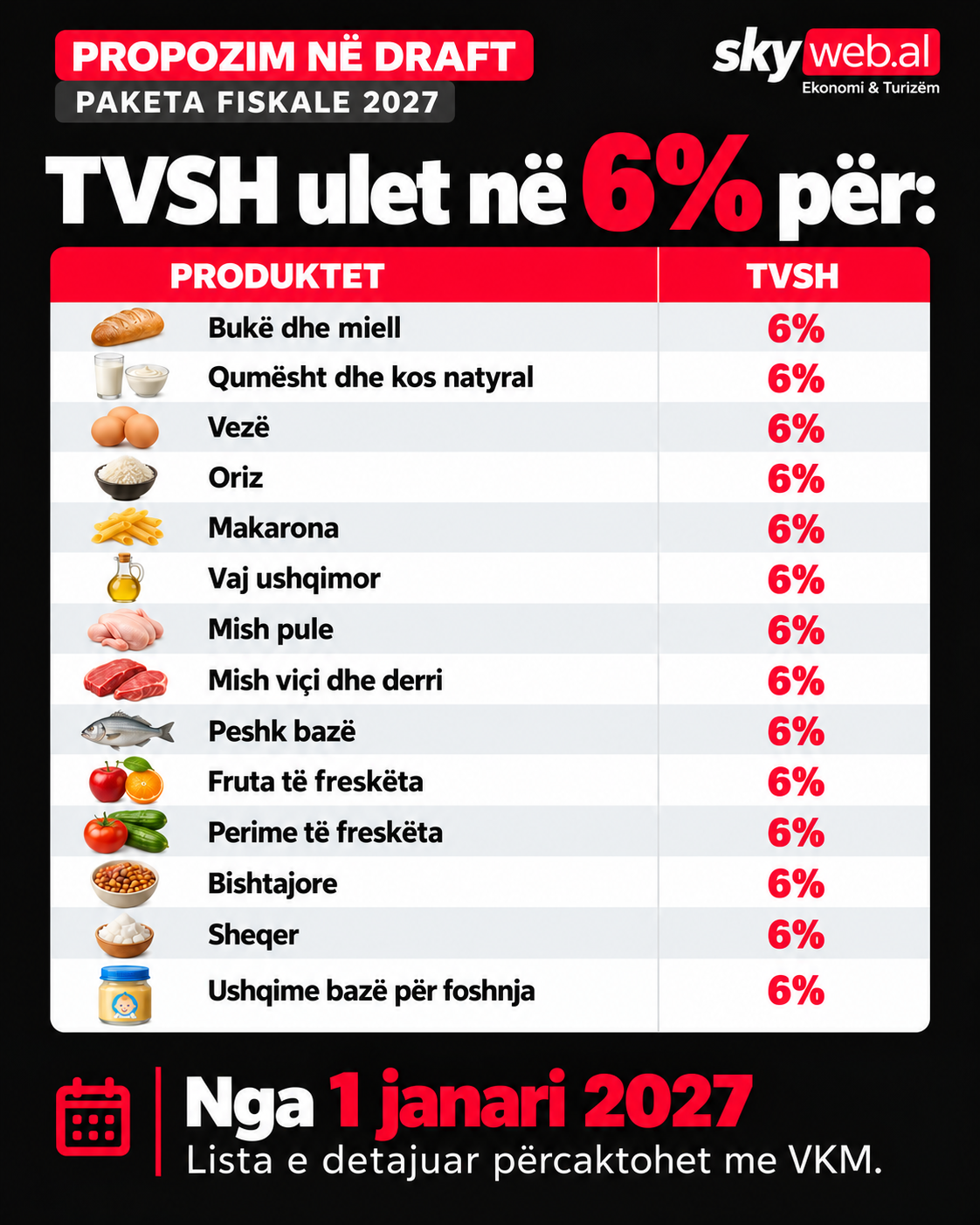
One of the most important changes for consumers is the proposal to reduce the VAT on basic food products from 20% to 6%.
The measure includes bread, flour, milk, plain yogurt, eggs, rice, pasta, cooking oil, chicken, veal, and pork, basic fish, fruits, vegetables, legumes, sugar, and basic baby food.
The aim is to ease the expenses of families, especially those with low and middle incomes, who spend a significant portion of their budget on food.
However, the VAT reduction does not automatically guarantee a corresponding decrease in prices. This will also depend on how retailers and suppliers reflect the tax change in their final prices.
The full list of products that will benefit will be determined by a decision of the Council of Ministers. According to government calculations, the reduction of VAT on food will cost the budget about 12.8 billion lek per year.
The general VAT rate increases from 20% to 21%
To compensate for a portion of the revenue that will be lost from the reduced VAT on food, the government proposes raising the general rate from 20% to 21%.
This change affects a wide range of goods and services that do not benefit from the reduced rates.
In practice, for a product that costs 1,000 lekë before VAT, the current tax is 200 lekë, while with the new rate it would be 210 lekë.
Although it’s only one percentage point, the effect could be felt across many sectors of the economy, including transportation, construction materials, and various services.
For businesses, the change also requires adapting billing and pricing systems. According to the Ministry of Finance, this increase is expected to bring about 10.6 billion lek additional revenue to the budget.
Tourism: VAT rises from 6% to 10%
Another sector that will face tax increases is tourism.
The government proposes that the reduced VAT for accommodation services, special-status hotels, and agritourism be increased from 6% to 10%.
Since 2017, these activities have benefited from a favorable tax treatment aimed at developing the tourism industry.
However, according to the Ministry of Finance’s argument, the sector has expanded significantly in recent years, while the benefits from the tax cuts have not necessarily translated into lower prices for tourists.
The VAT increase could leave operators with two options: absorb part of the extra cost themselves or pass it on to customers through higher prices.
From this measure, the government expects to collect about 614 million lekë more per year.
Businesses with a turnover over 5 million lekë will be subject to VAT
A change with a direct impact on small businesses is the lowering of the mandatory VAT registration threshold.
Currently, this requirement generally applies to businesses with annual turnover above 10 million lek. From 2027, the government proposes lowering the threshold to 5 million lek.
This means that a business generating 6 or 7 million lek in sales per year, even if it was not previously required to register for VAT, will have to be included in this scheme.
According to the Ministry of Finance, the change is expected to affect 17,516 new taxpayers.
For these businesses, inclusion in VAT brings obligations for tax reporting and administration, but also the right to deduct VAT on purchases related to their activity.
The impact on the final cost will depend on the type of business, the purchases it makes, and the ability to reflect the tax in its selling prices.
The government estimates that this measure will generate around 4.5 billion lek in additional revenue.
Corporate profit tax rises from 15% to 17%
Companies subject to the standard corporate profit tax rate are expected to pay more starting next year.
The government is proposing to raise this rate from 15% to 17%, increasing the tax businesses pay on their profits.
For example, a company with 10 million lek in taxable profit currently pays 1.5 million lek in corporate tax. Under the proposed rate, the liability would become 1.7 million lek, or 200,000 lek more.
The increase is intended to bring in about 5 billion additional lek to the state budget each year.
However, the 0% income tax rate, provided for entities with annual gross revenue up to 14 million lek, remains in effect until the end of 2029, according to legal provisions.
Therefore, the increase to 17% will not automatically apply to every small business.
The dividend tax rises from 8% to 15%
In addition to corporate profit tax, the government proposes to significantly increase the dividend tax, that is, on the profits that companies distribute to partners or shareholders.
The current rate of 8% is proposed to be raised to 15%.
If a partner receives 1 million lek in taxable dividends, they currently pay 80 thousand lek in tax. With the new rate, they will pay 150 thousand lek, or 70 thousand lek more.
The government argues that the change aims to encourage businesses to retain and reinvest a larger portion of their profits, rather than distributing them to the owners.
For companies that pay corporate income tax and then distribute the remaining profit as dividends, both taxes will affect the final amount that shareholders receive.
According to the Ministry of Finance’s calculations, the increase in dividend tax is expected to bring in about 3 billion additional lek per year.
Payroll taxation changes: relief up to 700,000 lek and a new 32% rate for high salaries
The fiscal package also intervenes in the way salaries are taxed.
Currently, the 23% rate applies to the portion of income that exceeds the corresponding gross salary threshold of 200,000 lekë per month.
The government proposes raising this threshold to 300,000 lekë, easing the tax burden for mid- and high-income employees.
For the portion of salary between 300,000 and 700,000 lek, the 23% rate will apply, while for the portion exceeding 700,000 lek per month, a new 32% rate is proposed.
This does not mean that a person with a salary above 700,000 lekë will be taxed at 32% on the entire salary. The higher rate will apply only to the portion of income that exceeds the specified threshold.
The change aims to lower taxes for some qualified professionals, while very high incomes will face a higher tax rate.
Prepayment of income tax, Tax authorities may use forceful collection
The package not only changes tax rates but also the way they are collected.
One of the proposals provides that the advance income tax installments will be considered tax liabilities as soon as the payment deadline expires.
This will give the tax administration the ability to use legal procedures to collect unpaid liabilities without waiting for the final annual profit declaration.
In practice, businesses that do not pay the advance installments on time may face enforcement measures to collect them.
The government justifies this change by citing the need to improve payment discipline and to prevent the accumulation of liabilities at year-end.
Stricter measures for cash payments and fines for documentation
Changes are also proposed for the enforcement of cash payment limits.
According to the package, a fine of 10% of the transaction value will also apply in cases where businesses make cash payments or receipts with consumers in violation of the legal limits.
Meanwhile, fines ranging from 100,000 to 150,000 lek are proposed for failing to submit the price transfer documentation within the required deadline when such documentation is requested by the tax administration.
The measures aim to strengthen control over transactions and compliance with obligations, while at the same time underscoring the importance of accurate financial management by businesses.
Tobacco excise tax increases; price hikes expected to continue until 2033
The fiscal package also proposes a new schedule for increasing excise taxes on tobacco products.
From January 1, 2027, the specific excise tax on cigarettes is proposed to increase from 7,750 to 8,100 lek per 1,000 sticks, or about 4.5%.
The increase will continue gradually in the coming years, while starting in 2030 an additional component tied to the retail sale price is also planned.
For consumers, this could translate into higher cigarette prices, depending on how manufacturers and importers pass on the cost.
Who benefits and who pays more under the new package?
Overall, the 2027 fiscal package represents a redistribution of the tax burden among consumers, employees, and businesses.
Families could benefit from the reduced VAT on food products, if this measure is reflected in retail prices. Some employees with salaries above 200,000 lek are also expected to pay less income tax.
On the other hand, companies that pay corporate income tax at the standard rate, partners who withdraw dividends, tourism operators, and businesses that will be included in the VAT scheme for the first time are expected to face new or higher obligations.
The increase in the general VAT rate may also affect the prices of other goods and services, partially offsetting for consumers the benefit of the reduced tax on food.
For the government, the objective is to increase revenues and broaden the taxpayer base. For businesses, the challenge will be to meet additional obligations without harming operations and competitiveness.
The changes remain proposals, and their implementation will depend on the final approval of the respective acts. If approved in this form, 2027 will bring a significant change in how consumption, labor, and business profits are taxed in Albania. /skyweb.al