



From Skyweb.al
After more than 130 days of flowers, perfume, children’s drawings, and flamingo-colored hues, for the past six days the protests have taken on a different look.

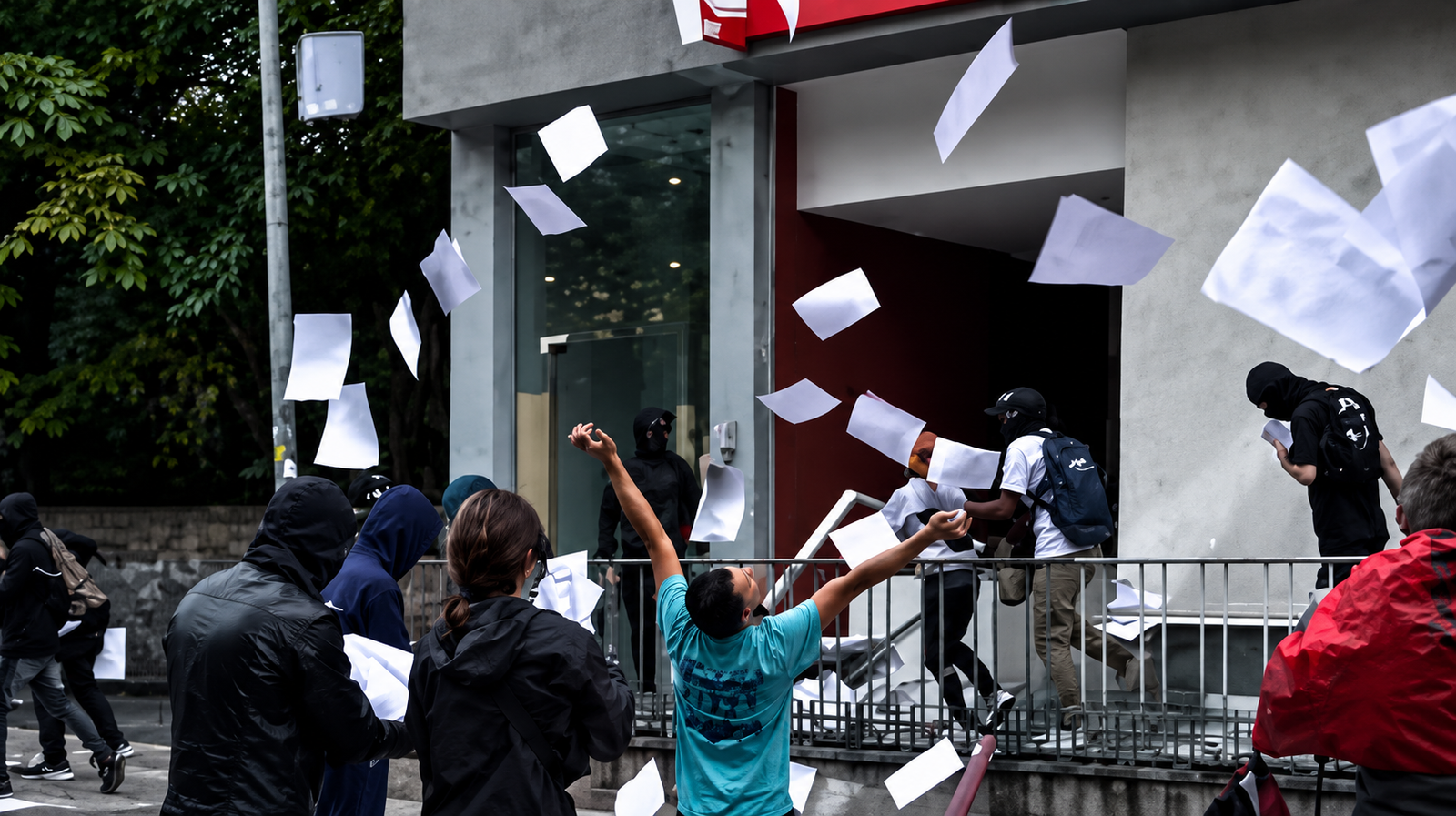
A portion of the protesters have chosen to express their revolt with stones and the destruction of private businesses, mainly banks, microcredit institutions, and telecommunications company stores. On the other hand, the police have used water, rubber batons, stones (!), and even rubber bullets.
What stands out is the approach of some protesters to target second-tier bank branches in downtown Tirana. Some of them have been destroyed. There have also been people who have gone inside, rummaging through the drawers in the hope of finding money, or others who have attacked ATMs with the same goal.
But bank branches are not places where money is left in drawers. Banks keep physical cash for customers’ daily transactions, while the storage and transport of cash are subject to special security measures.
Breaking the glass, destroying the furniture, or even getting into the teller window does not give you access to the bank’s money.
This is the case for those whose goal is to line their own pockets.
But not everyone is like that.
Among the protesters, there are also those who attack banks because they see them as representatives of the model of injustice and inequality they are protesting against.
But it must be understood that banks are the arteries of the economy.
Without their functioning, even the fulfillment of the protesters’ own demands is made more difficult.
How will funds be transferred from the Treasury to a company that will improve dormitory conditions, for example, except through the banking system?
How will the salary of a parent who is a teacher or doctor, whose child is protesting today, be deposited?
How will businesses make payments to employees and suppliers?
There are thousands of such examples.
Banks are not the enemy!
They are essential to the country’s financial and payment system, in addition to the role they play in supporting individuals and businesses with credit.
Banks are allies of citizens and businesses.
The Albanian banking market has developed significantly in recent decades and is an integral part of the economy’s functioning.
The frustration of some protesters is understandable.
But Credins Bank, Tirana Bank, BKT, Raiffeisen Bank, Union Bank, Intesa Sanpaolo, or other banks that have been attacked in recent days—both in their operating model and in their approach to customers—are not the same as Iute Credit, for example, whose branches were the first to be burned.
Protesters need to make this distinction.
Hitting the banks means disrupting the services that the protesters themselves and their families use every day.
Revolt against injustice does not triumph by damaging the arteries through which the economy functions. /skyweb.al