




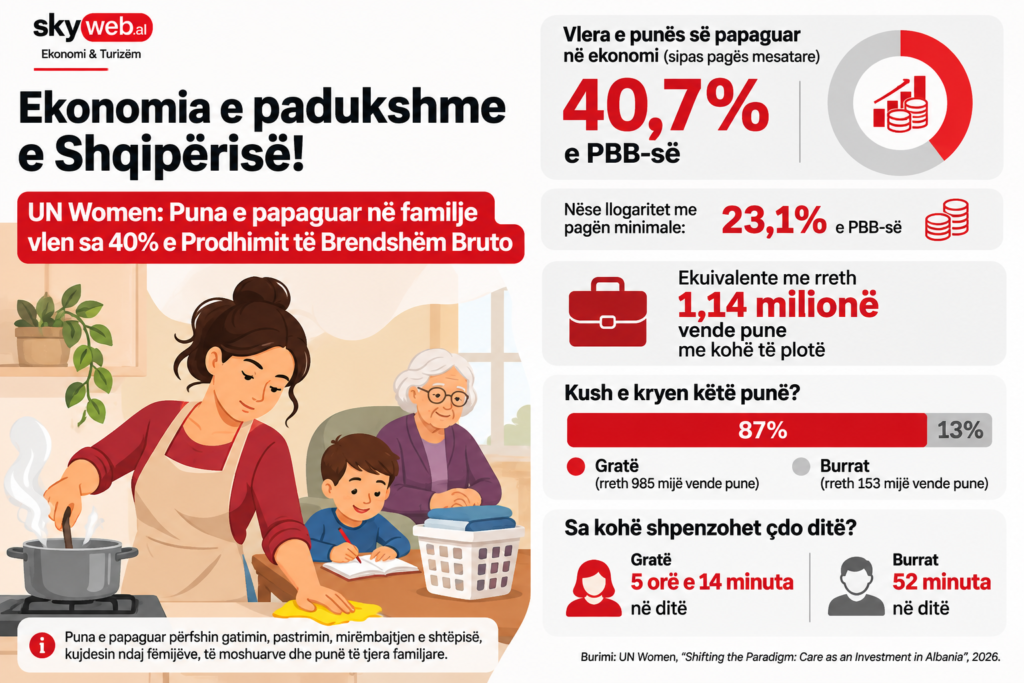
The work that Albanians perform every day in the family, from cooking and cleaning to caring for children and the elderly, has an economic value that can reach up to 40.7% of the Gross Domestic Product (GDP), although it is unpaid and not included in traditional economic calculations.
This is one of the conclusions of the 2026 UN Women report, “Shifting the Paradigm: Care as an Investment in Albania,” which analyzes the economic contribution of unpaid work and the need for investment in care services in Albania.

According to the study’s calculations, the unpaid work performed in Albanian households is equivalent to approximately 1.14 million full-time jobs, a figure almost equal to the total number of employed people in the country in 2023.
The vast majority of this work is performed by women. Of the equivalent 1,137,950 jobs, approximately 985,000 are performed by women and 153,000 by men. This means that women bear nearly 87% of the family’s unpaid workload.
The report shows that Albanian women spend an average of 5 hours and 14 minutes a day on cooking, cleaning, house maintenance, and caring for family members, while men devote only 52 minutes to these activities.
The gap is even more pronounced among the working-age population, 15–64 years old, where women spend an average of 5 hours and 47 minutes per day on unpaid work, compared to 50 minutes for men.
To calculate the economic value of this work, researchers used a method that converts the time spent into the equivalent of full-time jobs and then values it financially, using different wage levels.
Under the scenario that uses the average gross wage, the total value of unpaid work reaches up to 40.7% of GDP, while when the calculation is made with the minimum wage, it drops to 23.1%.
These figures do not represent income actually generated in the economy, but the value this work would have if it were financially compensated.
Beyond the invisible economic contribution, the report also highlights the consequences that the unequal distribution of household chores has on the labor market.
Women’s high level of involvement in caring for family members limits their opportunities for employment, professional advancement, and income security, also affecting their future pension levels.
According to UN Women, the lack of adequate childcare and eldercare services forces families, particularly women, to take on a significant portion of these responsibilities.
The study estimates that expanding care services could create around 11,869 new jobs, while simultaneously easing the burden of unpaid work and promoting women’s participation in economic activity.
To this end, the report estimates a need for approximately 13.2 billion lek in funding to improve service coverage for children and the elderly, excluding all construction and infrastructure expansion costs.
The 2026 analysis relies on the measurement of unpaid work time from the INSTAT 2010–2011 survey, combined with more recent demographic and economic data. For this reason, the results represent economic estimates and not a new measurement of the time used by Albanians in 2026. /skyweb.al