



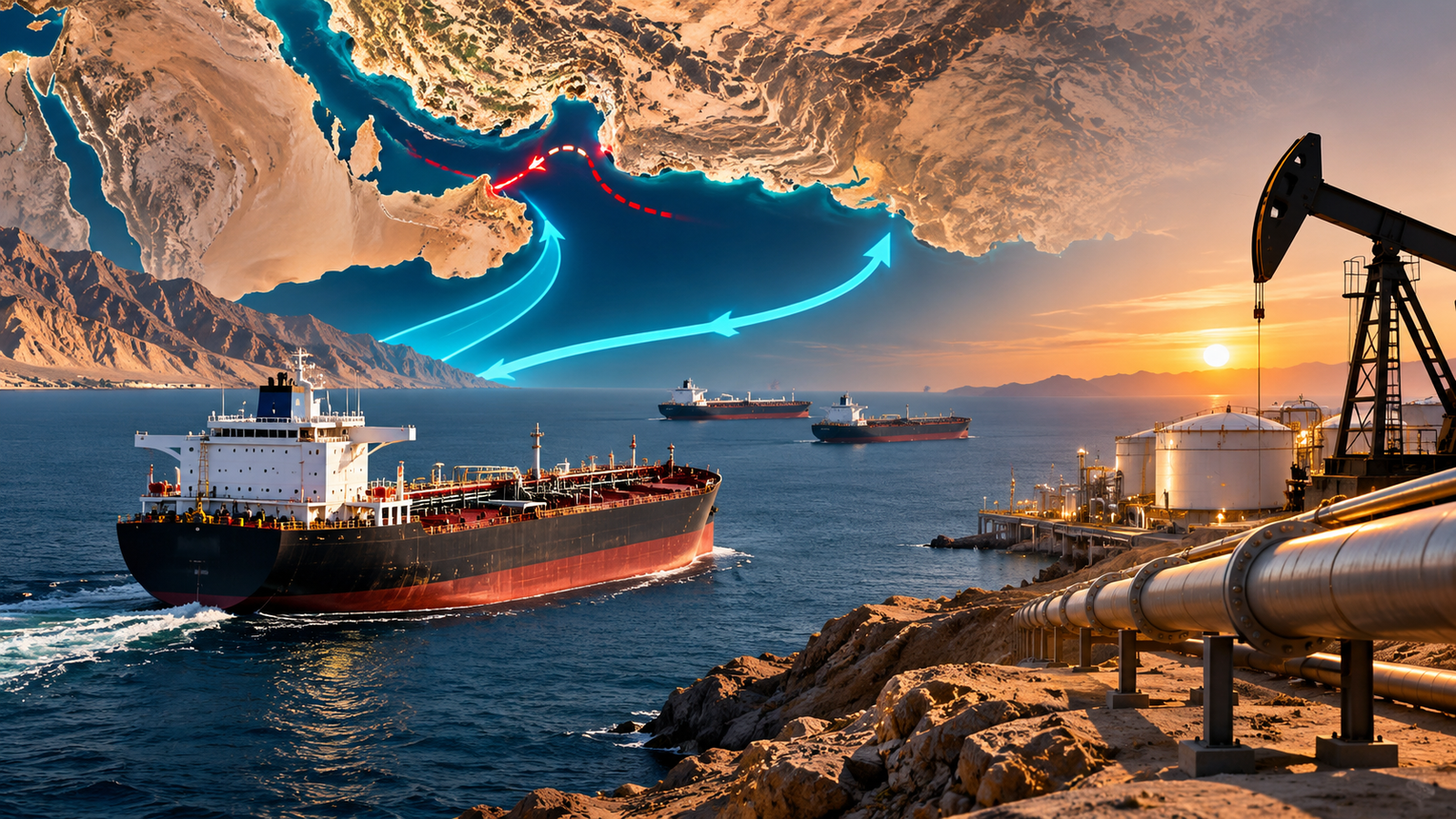
Oil could face a long-term shift in its global transportation map as investments increase to reduce dependence on the Strait of Hormuz, one of the world’s most strategic energy trade chokepoints.
The debate has returned to the forefront after analyses suggest that the development of alternative export corridors by the Gulf countries could gradually weaken Hormuz’s dominant role in the international oil market.

According to data from the International Energy Agency (IEA), around 20 million barrels of crude oil and petroleum products were passing through the Strait of Hormuz on average each day in 2025, or approximately one-quarter of global maritime oil trade.
However, the IEA estimates that scenarios and projects are being developed to increase exports via routes that bypass this geopolitical hotspot.
Currently, only Saudi Arabia and the United Arab Emirates have functional routes that can divert some oil flows away from the Strait of Hormuz, with alternative capacities estimated at 3.5 to 5.5 million barrels per day.
In Saudi Arabia’s case, some exports can go to ports on the Red Sea, while the Emirates use the line to the port of Fujairah in the Gulf of Oman.
According to the IEA’s medium-term scenarios, the construction of new corridors, the expansion of existing capacities, and a gradual decline in demand could lead to a very sharp reduction in dependence on Hormuz by 2035.
One of the scenarios mentioned by the agency forecasts that the need for transit through this strait will be reduced to around 2 million barrels per day by 2035, which represents a drop of more than 90% compared to current levels.
Such a development would have consequences not only for the oil market but also for the geopolitical balance in the Middle East, as it would reduce the strategic importance of a corridor that for decades has been considered the most delicate link in the global energy supply.
From an economic standpoint, a weakening of Hormuz’s role could help reduce the geopolitical risk premium often reflected in oil prices, especially during periods of military tensions or threats of passage blockades.
However, the IEA itself emphasizes that fully replacing Hormuz is not easy and cannot happen quickly, as most countries in the region remain heavily dependent on this sea route for their energy exports.
Data show that, even if alternative capacities expand, the Middle East will remain a key supplier to the global oil market, which means the region’s importance does not disappear but may only be redistributed across new export corridors.
Below I’m also including the new photo without text, with the same idea but with other visual elements. /skyweb.al